
Peace and Harmony: How Art Can Quiet the Noise of Modern Life

Peace and Harmony Painting by Haydn Englander Porter
Explore Peace and Harmony by Haydn Englander Porter, a monumental oil painting reflecting freedom, unity, consumer culture, and the calming power of art.
Peace and Harmony: How Art Can Quiet the Noise of Modern Life
There are moments in modern life when the world feels impossibly loud. Screens glow from every direction, headlines compete for attention, notifications interrupt silence, and the pace of daily living rarely slows long enough for reflection. Across Australia and around the world, people are searching for calm in increasingly busy lives. In many ways, art has quietly returned as one of the few places where stillness can still exist.
That feeling sits at the centre of Peace and Harmony, the latest monumental oil painting by Sunshine Coast contemporary artist Haydn Englander-Porter. The work is not political, nor does it point toward any one global event or social issue. Instead, it explores something far more universal: the human desire to reconnect with peace, imagination, optimism, and emotional balance through visual expression.
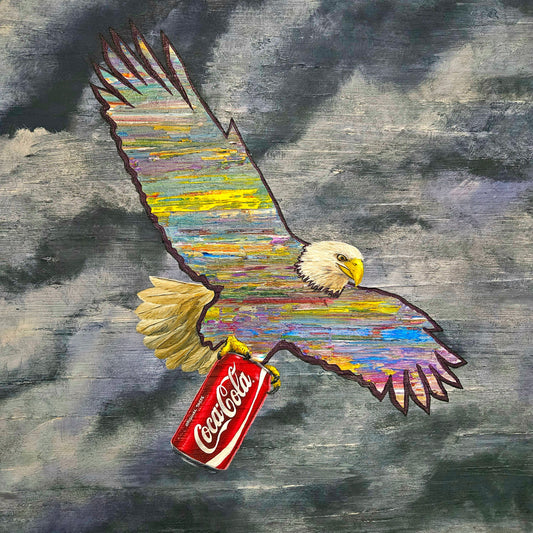
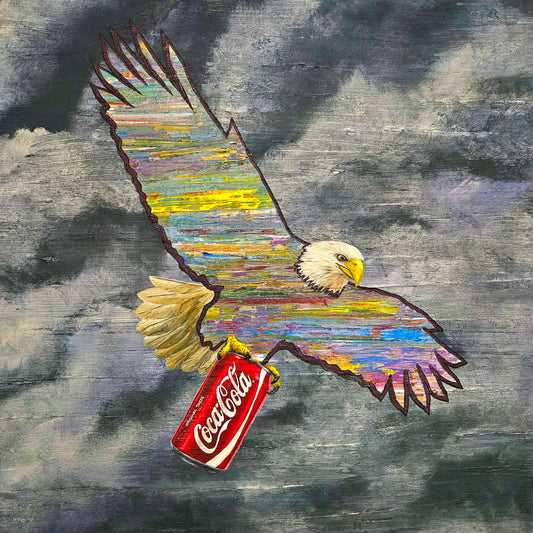
Painted on a grand scale at 212cm wide by 150cm high, Peace and Harmony presents a soaring eagle suspended against an immense atmospheric sky, carrying one of the most recognisable objects in global culture, the Coca-Cola can. In the hands of a lesser artist, the image might have become ironic or commercial. Here, however, it transforms into something symbolic, emotional, and strangely timeless.
The painting asks viewers to slow down and think about the role art once played in everyday life, and perhaps still can.
The Emotional Weight of Modern Noise
Modern society rarely offers silence. Even moments meant for relaxation are filled with distractions. Phones buzz during dinner, streaming services autoplay endlessly, and social media compresses attention spans into seconds. People consume information constantly, but genuine reflection has become increasingly rare.
Art offers a different experience. Unlike scrolling through a feed, standing before a large-scale painting demands presence. It asks the viewer to stop moving, even briefly. That pause matters.
In Australia, the renewed interest in galleries, creative spaces, and independent artists reflects a wider cultural shift. Many people are searching for experiences that feel human again. Art does not rush. It does not demand immediate reaction. Instead, it creates space for interpretation, emotion, and memory.
Peace and Harmony taps directly into this emotional landscape. Its towering composition and dramatic atmosphere create a sense of scale that cannot be replicated digitally. The eagle appears powerful yet calm, moving freely through the open sky while carrying an object tied deeply to collective memory and global culture.
There is no anger in the painting. No obvious conflict. No political slogan. Instead, the work quietly reminds viewers that peace often begins internally, through moments of stillness, imagination, and reflection.
The Symbolism Behind the Eagle
Throughout history, the eagle has represented freedom, strength, ambition, and vision. It appears across cultures as a symbol of aspiration and power, often associated with independence and possibility.
In Peace and Harmony, the eagle becomes more than a national or historical symbol. It feels almost spiritual, suspended in endless sky, detached from the chaos of the ground below. The bird carries movement and momentum, yet there is also grace in its flight.
What makes the image especially compelling is the contrast between the natural and the commercial. The Coca-Cola can, instantly recognisable across generations and continents, becomes transformed when lifted into the sky by the eagle. It shifts from an everyday product into modern iconography.
The result is layered and open-ended. Some viewers may see commentary on consumer culture. Others may see nostalgia for the optimism once associated with global branding and shared cultural experiences. Many will simply feel the emotional tension between freedom and modern identity.
That ambiguity is intentional. Great art rarely tells people exactly what to think.
Coca-Cola as a Cultural Symbol
Few objects are more globally recognised than the Coca-Cola can. For more than a century, it has represented far more than a drink. It became part of advertising history, cinema, music, sport, and modern visual culture.
Artists have long been fascinated by familiar commercial imagery because it reflects collective experience. From the Pop Art movement onwards, everyday objects were elevated into symbols of society itself. In Peace and Harmony, the Coca-Cola can serves a similar purpose.
Rather than criticising consumerism directly, the painting reflects on the emotional ideals once connected to it. Advertising often promised happiness, togetherness, optimism, and shared identity. Whether fully achievable or not, those messages shaped generations.
In today’s fragmented world, where division and noise often dominate public conversation, the painting revisits those older ideas of unity and collective joy. The can becomes less about commerce and more about memory, aspiration, and cultural symbolism.
The genius of the work lies in its restraint. It never becomes cynical. Instead, it feels reflective, almost hopeful.
Large Scale Art and Human Presence
There is something deeply physical about standing in front of a painting this large. At over two metres wide, Peace and Harmony cannot simply be glanced at. It surrounds the viewer.
Large-scale art changes the relationship between the artwork and the audience. It creates immersion. The sky feels endless, the eagle's movement becomes cinematic, and the emotional atmosphere expands beyond the edges of the canvas.
In recent years, oversized statement pieces have become increasingly sought after in Australian homes, galleries, and architectural spaces. Collectors are looking for works that create emotional presence rather than simply decorate walls.
That presence is central to Haydn Englander Porter’s approach as an artist. His work often combines abstraction, symbolism, and strong visual contrast, creating paintings that feel emotionally immediate while remaining open to interpretation.
Originally from Melbourne and now based on the Sunshine Coast, the artist has developed a distinctive visual language through years of professional practice. His internationally collected works, including the well-known Blue Trees series, continue to explore atmosphere, symbolism, and emotional storytelling through oil and acrylic painting.
With Peace and Harmony, that exploration reaches a particularly ambitious scale.
Why Art Still Matters in Difficult Times
Every generation experiences uncertainty in different ways. Economic pressures, social change, global conflict, and technological acceleration constantly shape public consciousness. Yet throughout history, art has remained one of humanity’s most enduring responses to instability.
People turn to music during grief. They visit galleries during periods of emotional exhaustion. They surround themselves with imagery that helps them feel grounded, inspired, or hopeful.
Art matters because it reconnects people to feeling.
This is especially important in an era dominated by speed and algorithm-driven content. Much of modern communication is designed for reaction rather than contemplation. Art slows that cycle down. It asks viewers to observe rather than instantly judge.
Peace and Harmony reflect this beautifully. The painting does not attempt to solve global problems or push ideology. Instead, it reminds viewers that peace often begins with awareness, imagination, and emotional openness.
The title itself feels intentional in its simplicity. Peace and harmony are not abstract political concepts here. They are emotional states, personal experiences, and aspirations that belong to everyone.
Contemporary Australian Art and Global Influence
Australian contemporary art continues to gain international attention for its willingness to combine local identity with global themes. Artists increasingly move between personal symbolism, popular culture, environmental themes, and emotional storytelling.
Haydn’s work sits comfortably within this evolving conversation. His paintings feel distinctly contemporary while remaining deeply painterly and human.
Unlike purely digital or conceptual work, his paintings retain the physical richness of oil on canvas. Texture, atmosphere, colour movement, and scale all contribute to the emotional impact of the finished piece.
In Peace and Harmony, the global symbolism of the eagle and Coca-Cola can intersect with a deeply personal artistic philosophy. The work ultimately argues for the importance of reflection in a world that rarely pauses.
That message resonates far beyond Australia.
A Painting Designed to Start Conversations
Some artworks exist quietly in the background. Others change the atmosphere of a room entirely.
Peace and Harmony belong firmly in the second category.
Its scale alone commands attention, but it is the emotional contradiction within the imagery that keeps viewers engaged. Freedom and consumerism. Strength and elegance. Noise and stillness. Familiarity and mystery.
The painting invites conversation without forcing a conclusion. Different viewers will interpret the work differently depending on their experiences, memories, and emotional state.
That openness is one reason why significant contemporary paintings continue to hold cultural value. They become mirrors as much as objects, reflecting not only the artist’s vision but also the viewer’s own thoughts and emotions.
In a world increasingly dominated by short-form communication and disposable imagery, paintings like Peace and Harmony remind people that some experiences still deserve time.
Reflecting Back on the Purpose of Art
At its core, Peace and Harmony is about remembering something simple yet essential: art has the power to reconnect people with themselves.
Not through politics. Not through outrage. Not through endless commentary.
Through reflection.
The painting encourages viewers to pause, breathe, and reconsider what peace and harmony might actually mean in modern life. Perhaps it is found in moments of silence. Perhaps it exists in creativity, imagination, or shared cultural memory. Perhaps it begins when people stop consuming noise long enough to truly observe something meaningful.
That is where art continues to matter most.
For centuries, paintings have captured the emotional atmosphere of their time while offering audiences an escape from it. Peace and Harmony continues that tradition in a distinctly modern way, combining contemporary symbolism with timeless emotional themes.
The result is a work that feels ambitious, cinematic, and emotionally generous all at once.
To explore more works by Haydn, visit Englander-Porter Art.
Tags:
Previous
Starship by Haydn, A Contemporary Australian Exploration of Power and Departure
Next
How Art Creates Peace and Harmony in a Busy World
Related Articles
The Flight by Haydn England...
Aug 25 2026
Butterflies 3 by Haydn Engl...
Aug 11 2026

Haydn Englander-Porter | Au...
Aug 04 2026
Coca-Cola Eagle, Freedom, C...
Jun 29 2026
New York City Butterflies: ...
Jun 19 2026

Why Watching an Artist Pain...
Jun 08 2026
Lavender Fields, The Emotio...
May 25 2026
How Art Creates Peace and H...
May 18 2026