
The Flight, A Dreamlike Meditation on Freedom, Light, and Becoming

The Flight Oil Painting by Haydn Englander Porter
Explore The Flight, a poetic oil painting capturing a great egret in motion, where light, colour, and quiet determination merge into a dreamlike visual story.
There are moments in nature that feel too delicate to hold, moments that pass in silence yet leave a lasting imprint on the soul. The Flight captures one of those moments, suspended between breath and movement, between stillness and release. This oil painting does not shout for attention. Instead, it invites the viewer closer, asking for quiet observation, for patience, for a willingness to drift into its atmosphere and let the story unfold slowly.
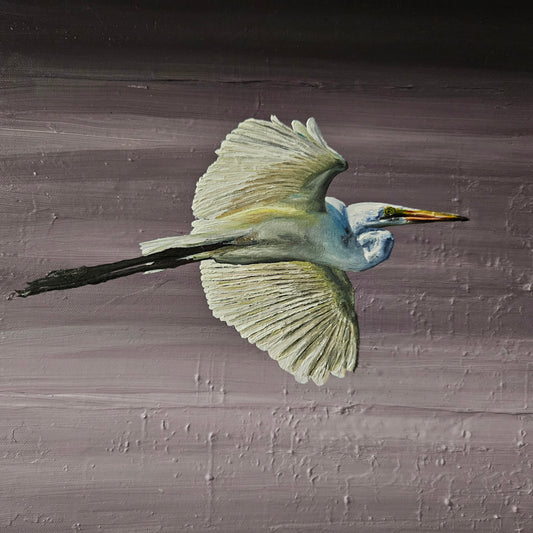
At the heart of the composition is a great egret, caught in mid-air as its wings open into a broad, graceful arc. The bird is neither landing nor departing in haste. It exists in a fleeting state of becoming, where motion is present but unforced. The egret appears weightless, as though the air itself is holding it aloft with gentle hands. This sense of effortlessness sets the tone for the entire painting, creating an emotional softness that lingers long after the first glance.
The white of the egret’s feathers is not stark or empty. It is layered, textured, and alive with subtle shifts of tone. Delicate brushstrokes define the feathers individually, yet they remain part of a unified whole. Soft hints of blue and grey ripple through the plumage, suggesting reflected sky and passing light. These colours do not overpower the white. Instead, they enrich it, giving depth and dimension to what could otherwise feel flat or static.
The wings themselves are a study in balance. Fully extended, they form a sweeping curve that guides the eye across the canvas. There is a natural rhythm to their shape, echoing the slow rise and fall of breath. This rhythm creates a sense of calm, as if the painting itself is breathing. The wings do not strain against gravity. They cooperate with it, moving in harmony with unseen currents.
The egret’s long neck curves forward with intention. There is purpose in its posture, yet no aggression or urgency. The sharp yellow beak points toward an unseen destination, suggesting direction without revealing the outcome. This choice invites the viewer to imagine what lies ahead, to project their own hopes or questions into that open space beyond the frame. The black legs trail behind, elegant and unobtrusive, completing the sense of forward motion without distraction.
Surrounding the bird is a background that feels less like a place and more like a mood. Faded violets and purples blend seamlessly into one another, creating an ethereal sky that could belong to dawn or dusk. Time feels ambiguous here, suspended in a liminal hour where night and day briefly coexist. The colours are applied in a soft, impressionistic manner, allowing edges to blur and forms to dissolve gently into the atmosphere.
This background does not compete with the subject. Instead, it supports it, wrapping the egret in a cocoon of quiet light. The muted tones enhance the brilliance of the white feathers, allowing them to glow without harsh contrast. This colour palette is serene, a sense of introspection that encourages slow looking rather than quick consumption.
The Flight is a painting that rewards stillness. The longer one gazes, the more subtle details begin to emerge. The way the feathers overlap, the faint transitions between violet and grey, and the almost imperceptible movement suggested by the brushwork. These elements work together to create a sense of continuous motion, even though the image itself is frozen in time.
There is poetry in this restraint. The artist does not rely on dramatic gestures or bold contrasts to convey emotion. Instead, the painting whispers. It speaks in the language of nuance, inviting the viewer into a contemplative space where meaning is felt rather than declared.
Birds have long carried symbolic weight in art, often representing freedom, transcendence, and the soul’s desire to rise above earthly constraints. In The Flight, the great egret embodies these ideas without becoming symbolic in an obvious or heavy-handed way. The symbolism is present, but it remains open, flexible, and deeply personal.
The egret’s flight can be read as a moment of liberation, a release from stillness into motion. It can also be seen as a journey inward, a quiet commitment to follow one’s own path, even when the destination is unknown. The absence of a defined landscape reinforces this ambiguity. There are no landmarks, no clear horizon lines, only colour and air and movement.
This openness allows each viewer to bring their own narrative to the painting. For some, it may evoke memories of early mornings by the water, watching birds rise silently into the sky. For others, it may mirror a personal transition, a moment of change where clarity is felt but outcomes remain uncertain. The painting does not impose a single story. It offers a space in which many stories can coexist.
The emotional tone of The Flight is one of quiet determination. There is strength here, but it is not forceful or loud. It is the strength of persistence, of steady movement guided by instinct rather than fear. The egret does not struggle against the air. It trusts it. This trust becomes a powerful undercurrent within the work, suggesting a way of being that is calm, intentional, and deeply connected to the surrounding world.
This sensibility aligns with Haydn's broader practice, whose work often explores the space between the external world and internal experience. Known for blending realism with abstraction, he creates paintings that feel grounded yet dreamlike, familiar yet elusive. His approach allows subjects to exist not only as visual forms but as emotional landscapes.
In The Flight, this balance is particularly evident. The egret is recognisable, rendered with anatomical care and observational skill. At the same time, the surrounding environment dissolves into colour and feeling, blurring the line between representation and impression. This duality creates a tension that keeps the painting alive, resisting easy categorisation.
The brushwork plays a crucial role in establishing this atmosphere. Feathers are suggested through light, controlled strokes, while the background is built through softer blending and layered washes of colour. This contrast mirrors the relationship between the tangible and the intangible, between the bird's physical presence and the emotional resonance of the space it inhabits.
Light in The Flight is gentle and diffuse. It does not come from a single, identifiable source. Instead, it emanates from within the scene itself. The white feathers catch this light naturally, glowing rather than reflecting. This internal luminosity enhances the painting’s dreamlike quality, making the egret feel almost otherworldly.
Despite this ethereal quality, the painting remains grounded. The egret’s form is solid, confident, and assured. There is no sense that it might vanish or dissolve entirely into the background. This grounding presence anchors the viewer, providing a focal point around which the softer elements can drift.
The sense of space in the painting is both expansive and intimate. The background stretches outward, suggesting a vast sky and open air, while the bird's closeness draws the viewer into a more personal connection. This interplay between scale and proximity creates an emotional depth that feels both expansive and inward-looking.
As a work of Australian contemporary art, The Flight resonates with the landscapes and wildlife that shape the country’s visual identity. The great egret, often seen in wetlands and coastal regions, carries with it associations of water, reflection, and quiet observation. These associations deepen the painting’s connection to place, even as the background remains abstract.
The painting does not depict a specific location, yet it feels deeply rooted in the rhythms of the natural world. It reflects an understanding of how light shifts at dawn and dusk, how birds move with grace rather than urgency, how moments of beauty often occur without spectacle.
There is also a meditative quality to The Flight that aligns with contemporary desires for slowness and presence. In a world saturated with noise and constant movement, this painting offers a pause. It encourages the viewer to breathe, to observe, to reconnect with the quieter aspects of experience.
This quality makes the painting particularly compelling within a living space. It does not dominate or demand attention. Instead, it quietly shapes the atmosphere of a room, offering a visual anchor for reflection and calm. Over time, its subtleties continue to reveal themselves, ensuring that the relationship between viewer and artwork evolves rather than stagnates.
The Flight feels less like a captured image and more like a shared moment. It invites empathy not only with the bird but also with the state of motion it represents. That in-between space where one has committed to movement but has not yet arrived. Where intention is clear, but outcomes remain open.
In this way, the painting becomes a mirror. It reflects the viewer’s own experiences of transition, growth, and quiet resolve. The egret’s flight is not dramatic or triumphant. It is honest, measured, and deeply human in its restraint.
As the eye moves across the canvas, there is a sense that the moment will extend beyond the frame. The wings will complete their arc, the bird will glide forward, and the colours will shift as light changes. This sense of continuity is one of the painting’s greatest strengths. It refuses to feel final or closed. Instead, it remains alive with possibility.
The Flight is ultimately a meditation on freedom, not as escape, but as alignment. The egret is free because it moves in accordance with its nature, trusting its instincts and the currents that support it. This vision of freedom feels grounded and attainable, rooted in presence rather than conquest.
In viewing this painting, one is reminded that some of the most profound moments are the quiet ones. The moments that pass without announcement, yet leave a lasting resonance. The Flight captures such a moment with grace, sensitivity, and poetic clarity.
For those drawn to art that speaks softly yet deeply, this painting offers a lasting connection. It stands as a testament to the beauty of motion, the power of restraint, and the quiet courage required to take flight.
To view or enquire about this artwork, visit
https://englanderporter.com/products/the-flight
Tags:
Previous
Black Crow Cream of Mushroom, A Symbolic Dance Between Mystery and Meaning
Next
Starship, A Dream of Fire Gold and the Human Urge to Go Beyond
Related Articles
The Flight by Haydn England...
Aug 25 2026
Butterflies 3 by Haydn Engl...
Aug 11 2026

Haydn Englander-Porter | Au...
Aug 04 2026
Coca-Cola Eagle, Freedom, C...
Jun 29 2026
New York City Butterflies: ...
Jun 19 2026

Why Watching an Artist Pain...
Jun 08 2026
Lavender Fields, The Emotio...
May 25 2026
How Art Creates Peace and H...
May 18 2026