
Butterflies: A Quiet Study of Change, Memory, and Emotional Freedom

Butterflies Painting Meaning and Symbolism
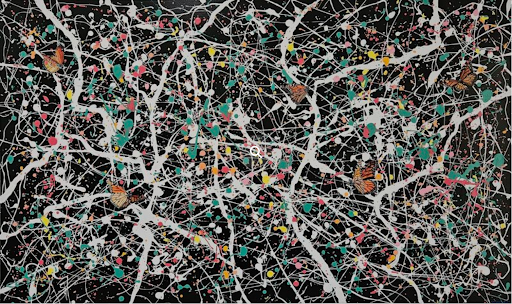
Butterflies is a contemplative and emotionally resonant painting by Australian contemporary artist Haydn Englander Porter, offering a visual meditation on transformation, vulnerability, and the unseen shifts that shape human experience. At first encounter, the work feels gentle and open, drawing the viewer in through its softness and sense of motion. Yet beneath this calm surface lies a layered exploration of change, both personal and universal, expressed through symbolism rather than narrative.
Butterflies have long been associated with transformation. Their life cycle, from caterpillar to winged form, mirrors the process of growth and renewal experienced throughout life. In this painting, the butterfly motif is not presented as decoration or a simple metaphor. Instead, it functions as an emotional anchor, representing moments of transition that often occur quietly, without announcement or certainty. These are the changes that reshape identity over time, leaving subtle but lasting impressions.
Englander Porter approaches this subject with restraint. The butterflies are not rendered with sharp realism or dramatic contrast. They appear as part of a wider emotional field, integrated into the composition rather than isolated from it. This choice reinforces the idea that transformation is not an event but a process, unfolding gradually and often unnoticed until its effects are fully realised.
Colour plays a significant role in communicating this theme. Soft tonal shifts suggest movement and impermanence, while maintaining a sense of balance and calm. There is no sense of urgency in the palette. Instead, the colours breathe, allowing space for reflection. This measured approach invites the viewer to slow down and consider their own experiences of change, rather than reacting to the image purely on a visual level.
The butterflies themselves can be read as symbols of release. They evoke the idea of letting go, of shedding former selves and stepping into something new. Yet there is also fragility in their presence. Butterflies are delicate, easily disrupted. This duality speaks to the emotional reality of change. Growth often brings freedom, but it can also expose vulnerability. Butterflies captures this balance with sensitivity, avoiding sentimentality while embracing emotional truth.
There is a quiet optimism in the painting, but it is not naive. The work does not suggest that transformation is easy or linear. Instead, it acknowledges uncertainty. The butterflies do not follow a rigid pattern. Their movement feels organic, slightly unpredictable. This reflects how personal change often unfolds, shaped by external forces as much as by internal intention.
Negative space is used thoughtfully throughout the composition. Areas of openness allow the butterflies to exist without confinement, reinforcing themes of freedom and possibility. At the same time, this space encourages introspection. The viewer is not overwhelmed with detail. Instead, they are given room to project their own meaning onto the work, making the experience personal rather than prescriptive.
Within the broader context of Englander Porter’s practice, Butterflies aligns with his ongoing interest in emotional symbolism and intuitive storytelling. While stylistically distinct from his Blue Trees series, the painting shares a similar philosophy. Meaning is suggested rather than stated. The artwork acts as a starting point for reflection, not a conclusion.
The absence of human figures is notable. Rather than depicting people undergoing change, the artist allows the butterflies to stand in for human emotion. This abstraction creates distance, which paradoxically makes the work more accessible. Viewers are not asked to identify with a specific character or story. Instead, they are invited to recognise universal feelings within themselves.
Butterflies can also be read as a meditation on time. The fleeting nature of butterflies mirrors the fleeting nature of moments that define our lives. Important shifts often pass quickly, only understood in hindsight. The painting holds these moments still, offering the chance to observe and honour them without rush.
Texture and layering add depth without distracting from the central theme. The painting's surface suggests history, as though the image has emerged through accumulation rather than sudden creation. This reinforces the idea that transformation is built over time, shaped by experience and memory.
Emotionally, the painting sits in a space between reflection and release. It acknowledges what has been, while remaining open to what may come next. There is no sense of finality. The butterflies are mid-movement, suspended in a moment that feels both complete and ongoing. This tension gives the work its quiet strength.
For many viewers, Butterflies may resonate during periods of personal change. It offers reassurance without certainty, comfort without answers. The painting does not promise outcomes. Instead, it validates the experience of being in transition, recognising its complexity and emotional weight.
In interior spaces, the artwork brings a sense of calm and openness. Its symbolism unfolds over time, shaped by the lives and conversations that surround it. As circumstances change, so too may the meaning drawn from the painting. This evolving relationship is central to its enduring appeal.
Butterflies is ultimately about trust. Trust in process, trust in change, and trust in the unseen forces that guide growth. Through subtle symbolism and thoughtful composition, Haydn Englander Porter creates a work that feels intimate yet expansive, grounded yet open-ended.
To explore this artwork further or to enquire about availability, visit
https://englanderporter.com/products/butterflies-3
Tags:
Previous
Nocturnal, A Dreamlike Passage Through Silence, Shadow, and Inner Knowing
Next
Alphabet Soup With Peacock: Exploring Identity, Imagination, and Symbolic Storytelling
Related Articles
The Flight by Haydn England...
Aug 25 2026
Butterflies 3 by Haydn Engl...
Aug 11 2026

Haydn Englander-Porter | Au...
Aug 04 2026
Coca-Cola Eagle, Freedom, C...
Jun 29 2026
New York City Butterflies: ...
Jun 19 2026

Why Watching an Artist Pain...
Jun 08 2026
Lavender Fields, The Emotio...
May 25 2026
How Art Creates Peace and H...
May 18 2026